
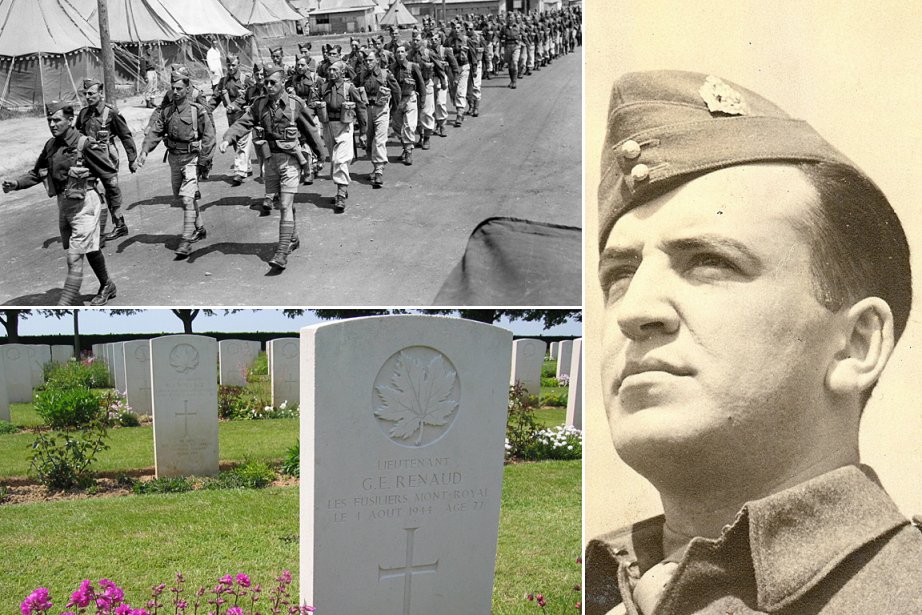
Guy Renaud, husband and father of two children, enrolled as a volunteer in the Canadian Army and was sent to combat in July of 1944. His widow later received the news that it was in a village in Normandy, while he was studying maps of the region, that he was hit by a sniper hidden in a church bell tower. He died instantly, after 10 hellish days of blood and fire. Before he left, this father of two had a head of black hair, and by the time he died all his hair had turned white.
This man, who gave his life for his country, was the great-grandfather of my two children. Two years ago, to honour his memory, we went on site with our son Christophe, in the footsteps of his great-grandfather.
In 2012, La Presse published an article with a picture. The family then recognized Guy Renaud leading his squadron. We have very few memories of him, and my in-laws went to great lengths to get that picture. The newspaper then published a new article entitled: “Le Noël du lieutenant Guy Renaud” (Lieutenant Guy Renaud’s Christmas).
While visiting Montreal, A Frenchman read the article and contacted a friend, who was an expert on the Normandy invasion. Considering the time of death of the lieutenant, and after some research into regiment movements, they established that he lost his life probably between St-André and May-sur-Orne. These were the first accurate details that we had received, 69 years after the death of the lieutenant. We had never known where it had actually happened.
We started our trip to Normandy with a visit to Juno Beach, hoping to better understand the scope of the invasion. As we were returning, our navigation system malfunctioned and led us astray. That is when I saw a road sign indicating the village of May-sur-Orne, and realized that without our knowledge, we had probably taken the same road that Lieutenant Renaud had, and that we may have been very near the area where he died. Another surprise: we were on the street called Fusilliers Mont-Royal, which was the name of his regiment. We had to take a picture. While posing in front of the street sign, a lady who was observing us asked us what we were doing there.
She then told us that her mother had seen the regiment enter the village. We became very emotional when we realized that she may very well have seen the Lieutenant’s “men”, only a few days after his death.
On Saturday, August 3rd, 2013, we visited the Bretteville-sur-Laize cemetery, where laid the remains of Guy Renaud. Almost 90% of French Canadian soldiers from the Second World War were single. As such, a young family visiting a grave in this cemetery is rare: our veterans may slowly be forgotten because they had no descendants. A man, intrigued by our little group, came to introduce himself, he was Mr. Le Baron, mayor of Cintheaux and president of the Juno Canada Normandy committee. He wanted to invite us to the official ceremony that was to be held the next day at the cemetery.
We were a bit reluctant (there is so much to see in Normandy!), so we returned to the grave one last time, and that is when we saw the date of his death: August 4th, and we were the 3rd. We then became overwhelmed with the desire for closure, so we returned the next day to the cemetery, on August the 4th, 2013, 69 years after the lieutenant’s death.
It was a magnificent ceremony, attended by a number of dignitaries and veterans. The Mayor addressed the audience and asked us to come forward. He then told the people how, the previous day, he had found us on our knees, putting flowers and family pictures on the grave of a Canadian war hero, underlining this great event that was the day of his death coinciding with the day of the ceremony.
All the Canadians sang our national anthem, O Canada, and many wreaths and flowers were handed out. Sixty-nine years after his death, a first formal tribute was given that day to Lieutenant Renaud, by this gathering, in front of his grandson and great-grandson, braking him free of the anonymity he was sharing with his brothers in arms.
The story does not end here however. In 2014, my in-laws made the same trip to celebrate the 70 years of the invasion. They met Mr. Le Baron who invited them in turn to the ceremony where they were given a posthumous medal.
The descendants of Lieutenant Renaud are deeply grateful to the French people for this generous tribute and mostly, to have given us the opportunity to finally be able to offer an actual funeral to our dearly departed.
We made our children promise to return one day to the grave of Lieutenant Renaud. They are part of the eternal life of this man, dead in 1944 at the age of 27, in a country that was foreign to him, and far from his beloved Mariette and his children Francine and Henry.
On this Remembrance Day, I wanted to share this story, hoping that somewhere, one of our veterans reads it, and realises that those who follow will not forget them, even 71 years later.

